
Why I Created the Invitation Compass — And What It Means for Your Wedding Invitations
The honest story of how one difficult experience changed everything about how I work.
There's a bride whose wedding taught me everything.
She came to me with something deeply personal at the center of her vision. She and her fiancé shared the same first initial — and she wanted that reflected in their suite in a way that felt intentional, not generic. So I designed a custom duogram: two letters, one feminine and one masculine, woven together into something completely their own.
She loved it. And then the rest of the process fell apart.
Not because the design wasn't beautiful. Not because she didn't care. But because I gave her one option — one single direction — and asked her to decide if it was right.
It wasn't. And she didn't know how to tell me what she wanted instead, because she'd never seen what else was possible.
One option isn't a choice. It's a guess dressed up as a decision.
That experience stayed with me. And instead of moving past it, I decided something good had to come from it.
What my process looked like before
I'll be honest with you — because I think honesty is real life.
Before I rebuilt my process, I was working from a moodboard template. One page, three images, a color palette. I'd present a single mockup and ask my client what she liked. From there, we'd move through revisions until something stuck.
I was focused on print methods — letterpress, foil, digital — rather than the story behind the suite. I was giving clients an à la carte menu of add-ons and calling it custom. I was charging luxury prices for an experience that, if I'm completely honest, wasn't one.
One design direction. One starting point. One guess about what she wanted.
For some brides, it worked well. But for the bride with the duogram — the one who knew exactly what was meaningful to her but had no framework for what the rest could look like — it wasn't enough. Not even close.
The moment everything changed
After that experience, I sat down and asked myself a different question. Not what went wrong — but what did she actually need that I wasn't giving her?
The answer was simple and a little humbling. She needed to see the range of what was possible before she could know what she wanted. She needed options — not endless ones, because endless choices are just as paralyzing as no choices — but a thoughtful few. Distinct enough to feel genuinely different. Curated enough to feel manageable.
She needed a compass. Not a single direction.
I spent time thinking through what that could look like. I brainstormed, journaled, talked it through out loud until the shape of it started to emerge. And somewhere in that process, I landed on three paths. Three distinct creative directions, each one going a little further in imagination and investment than the last.
I named them the way a compass names its directions — not north, south, east, west, but something that felt more like an invitation than a coordinate. And because Lord of the Rings is my favorite trilogy of all time, the names came naturally.
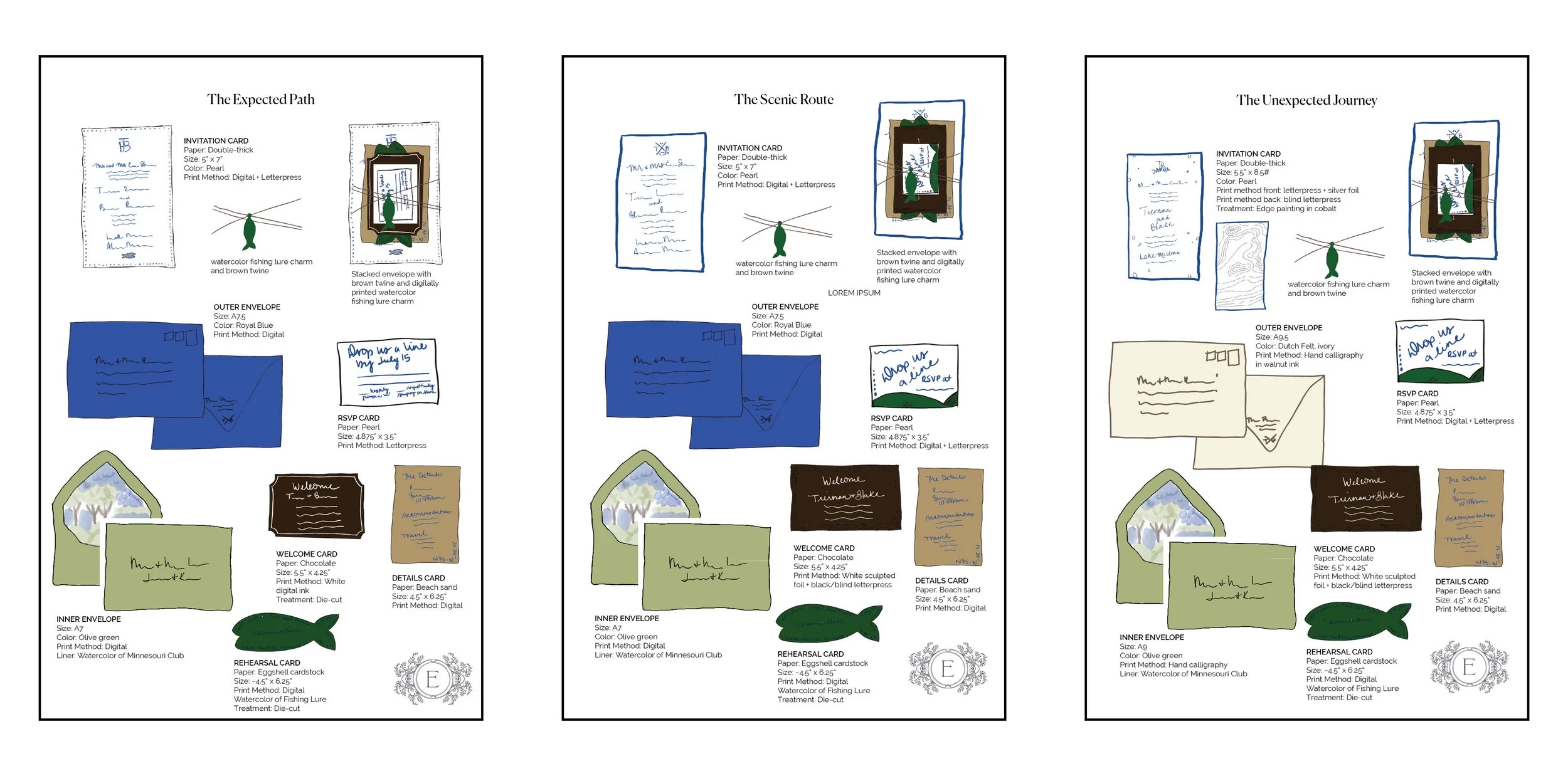
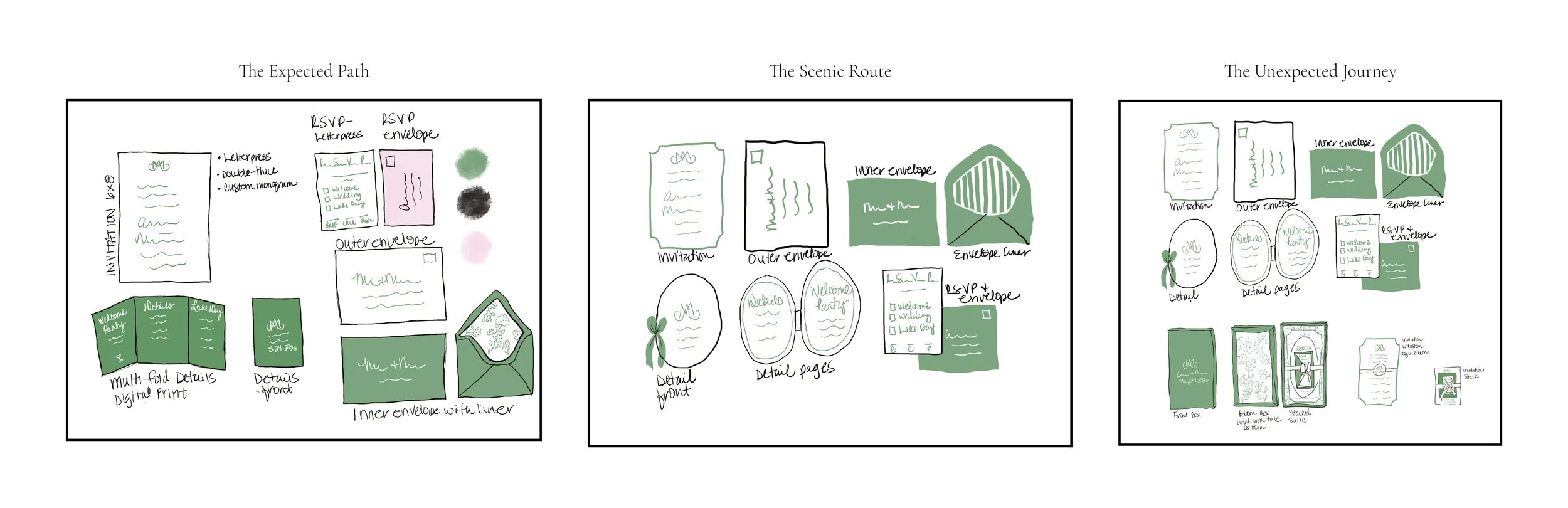
The Expected Path
The direction that feels most aligned with your wedding's established aesthetic. Refined, cohesive, and exactly what you'd hope for — executed at the highest level.
The Scenic Route
A direction that takes the foundation of your wedding and adds something unexpected. A detail you hadn't considered. A layer that makes the suite feel more personal, more dimensional, more you.
The Unexpected Journey
The direction that surprises even you. Bolder, more creative, further from convention — and often the one that makes people say they never knew they wanted it until they saw it.
Each path is personalized to your wedding specifically — your venue, your date, your aesthetic, the details that matter to you. I'm essentially pre-designing before design officially begins. Some paths include die-cut shapes. Some incorporate unique inserts or unexpected materials. All of them are built around the story you're trying to tell.
What it looks like when a bride receives it
The Invitation Compass arrives after our discovery call — a personalized document unlike anything a bride has typically seen in this process. Three complete creative directions, each one distinct, each one rooted in her wedding specifically.
Not sure where you fall on the invitation timeline? This free tool gives you a personalized answer in 30 seconds. →
She can take her time with it. Share it with her mother, her fiancé, her wedding planner. Talk it through. Mix elements from different paths. Come back to me with questions.
There's no pressure to decide immediately. That's the point. The Compass exists so she can find her direction — not so I can push her toward one.
"Wow. You absolutely outdid yourself. My parents and I were in awe last night as we were looking the options over. We are so excited to work with you."
— A RECENT BRIDE, UPON RECEIVING HER INVITATION COMPASS
That response — we were in awe — is what the process is designed to create. Not just a reaction to the designs themselves, but to the experience of feeling seen. Of opening something that was clearly made for you specifically, not adapted from a template or recycled from a previous client.
Why this matters beyond the invitations
Something I've noticed over time: the overwhelm brides feel about invitations isn't really about invitations. It's about the unknown. About not knowing how to start, what to ask for, how to translate the feeling of their wedding into something on paper.
And that feeling doesn't just live with the bride. Wedding planners feel it too. Most planners — even the most experienced ones — have no framework for guiding their clients through the stationery process. They know what looks beautiful. They don't always know how to get there.
The Invitation Compass gives everyone a shared language. A starting point. A way to talk about direction, creativity, and investment without the conversation feeling overwhelming or undefined.
It turns out that what brides need most isn't fewer decisions. It's better ones — curated, considered, and presented in a way that makes the path forward feel clear.
Every bride I work with receives this now.
From the very first wedding invitation I designed after rebuilding my process, the Compass has been part of how I work. Not as an add-on. Not as a differentiator I advertise. Just as the way things are done — because it's the right way to do them.
If you're somewhere in that anxious unknown right now — not sure how to start, not sure what you want, not sure how to turn the pieces of your story into something beautiful — that's exactly what this process is for.
You don't need to arrive with a vision fully formed. You just need to begin.
The Compass takes it from there.
Ready to find your direction?
If you'd like to understand the full custom invitation process before we connect, this post walks you through every step — from first conversation to your guests' mailboxes. Or if you're ready to begin, I'd love to hear about your wedding.